Short answer: yes, you can have vaginal dryness while pregnant, although most people notice more moisture, not less. The NHS lists pregnancy and breastfeeding among the causes of vaginal dryness [1], while Cleveland Clinic explains that higher progesterone usually increases vaginal discharge [2]. When pregnancy does feel dry, the cause is often less arousal, tiredness, worry about pain, or an infection rather than a lack of fluid. Here is what the research shows, how to tell dryness from discharge or infection, and what is safe to try.
What to know first
- Dryness in pregnancy is possible but less common than extra discharge. Higher progesterone makes the cervix produce more mucus [2].
- Sexual difficulties are very common in pregnancy. In one study of 207 pregnant women, 87% scored in the sexual-dysfunction range, with the highest rate in the third trimester [4].
- Pain or itching with dryness can be a yeast infection, which is more likely during pregnancy [6][7]. Get it checked rather than guessing.
- A water-based, fragrance-free lubricant before sex is the simplest fix [1]. Ask your midwife or doctor before using any new vaginal product.
Is vaginal dryness common during pregnancy?
No single study measures how many pregnant women feel dry, but problems with lubrication show up often in studies of sex during pregnancy. In a Brazilian study of 225 women at 26 to 34 weeks, 66.7% were at risk of sexual dysfunction, and the authors note that lubrication may fall and lead to “discomfort/pain” [3]. In a Turkish study of 207 pregnant women, 87% had sexual dysfunction, and the most common worry about sex was fear of pain (35%) [4].
A review of 48 studies found that sexual function declines during pregnancy, “particularly in the third trimester,” and that the decline can last 3 to 6 months after the birth [5]. So if sex feels drier or less comfortable than before, you are far from alone.
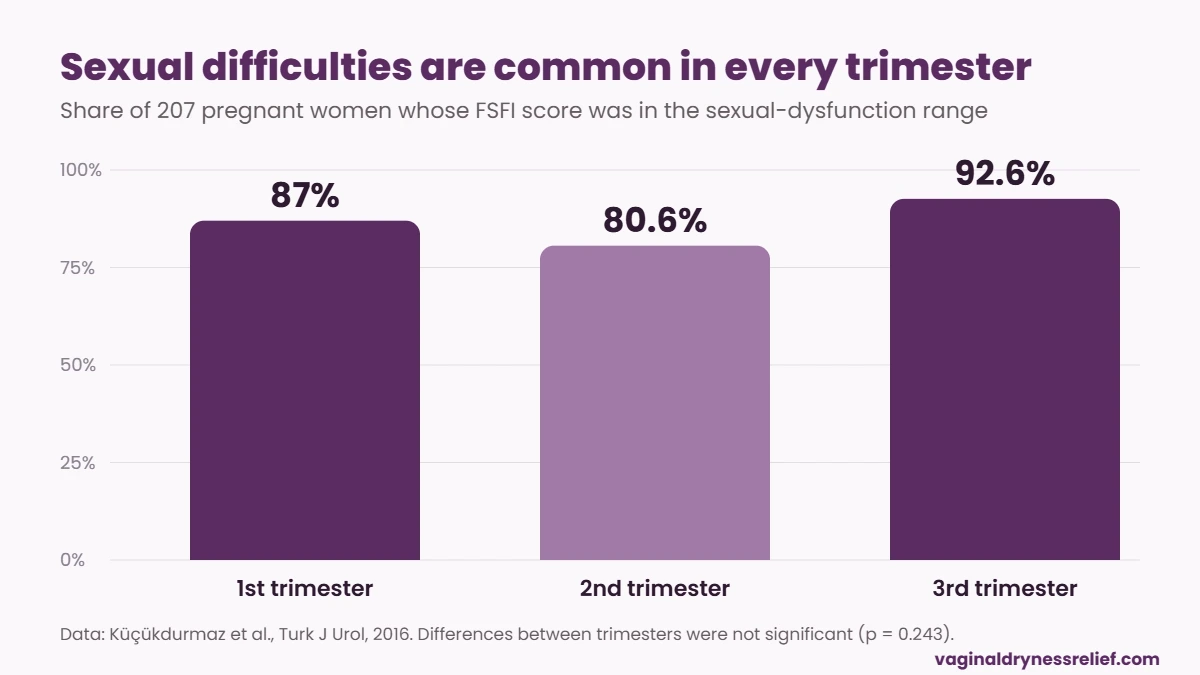
| Trimester | Women in the sexual-dysfunction range | Average FSFI score |
|---|---|---|
| First | 87% | 19.1 |
| Second | 80.6% | 19.9 |
| Third | 92.6% | 17.2 |
Why pregnancy can leave you feeling dry
Pregnancy hormones mostly add moisture, so dryness usually comes from something else. These are the common reasons:
- Hormone shifts. Progesterone rises sharply. It increases cervical mucus [2], but researchers have also suggested that high progesterone may reduce vaginal lubrication during arousal for some women [3].
- Lower desire and arousal. Nausea, tiredness and a changing body can lower desire, especially in the first and third trimesters [5][9]. Less arousal means less natural lubrication. Our guide to low libido and vaginal dryness explains the link.
- Worry about pain or harm. Fear of pain and of harming the pregnancy were the top concerns in the Turkish study [4]. Tension makes it harder to relax and get aroused, and stress can play a part in dryness at any age.
- Infections. Pregnancy makes vaginal yeast infections more likely [6][7]. They can cause itching, soreness and pain during sex that can feel like dryness.
- Irritating products. Perfumed soaps, washes and douches can dry and irritate the vulva and vagina [1].
Dryness, discharge or infection? How to tell
Changes “down there” are common in pregnancy. This table sums up what the sources describe, but it is not a way to diagnose yourself.
| What you notice | What it may be | What to do |
|---|---|---|
| More clear, white or pale yellow discharge, thin, no smell or itching | Normal pregnancy discharge [2] | Nothing; wear breathable underwear |
| Dry, tight or sore feeling, mostly during sex, no unusual discharge | Lower arousal or vaginal dryness [1][3] | Water-based lubricant, more time for arousal; mention it at your next visit |
| Itching, soreness, thick white “cottage cheese” discharge, pain during sex | Possible yeast infection [2][6][7] | Call your midwife or doctor before using any treatment |
| Green, gray or dark yellow discharge, or a strong smell | Possible infection [2] | Call your midwife or doctor |
| Clear fluid leaking, or bleeding (more than light spotting) | Possible leaking amniotic fluid or a problem that needs care now [2][8] | Go to the emergency room or call your maternity unit right away |
For more on itchy or burning symptoms, see our guide to vaginal itching, burning and dryness, and read can vaginal dryness cause bleeding? for spotting after sex.
What helps with vaginal dryness during pregnancy
Gentle, simple steps are the place to start. Check with your midwife or doctor before trying any new product inside the vagina while you are pregnant.
- Use a water-based lubricant before sex. The NHS recommends this for vaginal dryness [1]. Choose a fragrance-free one. Our guide to moisturizers vs. lubricants explains the difference.
- Skip perfumed soaps, washes and douches. Wash the vulva with water or an unperfumed wash [1]. Cleveland Clinic also advises against douching and vaginal sprays to help prevent yeast infections [7].
- Give arousal more time. Slow down, try different positions as your bump grows, and talk with your partner about what feels comfortable. The review authors say couples should be told that changes in desire are common [5].
- Ask about a vaginal moisturizer if dryness is constant. The NHS lists vaginal moisturizers for ongoing dryness [1]. Ask your clinician which are suitable in pregnancy. Our vaginal moisturizer guide covers how they differ from lubricants.
- Get any itching or unusual discharge checked. Do not self-treat a suspected yeast infection in pregnancy without asking your clinician first [6][7].
- Wear breathable cotton underwear and change out of damp clothes, which helps you stay comfortable [7].
Is sex safe when you feel dry?
In a healthy pregnancy, yes. Mayo Clinic says sex “won’t cause a miscarriage” and will not affect the baby if you do not have problems such as preterm labor or placenta problems [8]. March of Dimes says it is fine to have sex in a healthy pregnancy unless your provider tells you otherwise [9].
Your provider may advise you to avoid sex if you have vaginal bleeding, leaking amniotic fluid, placenta previa, a weak (incompetent) cervix, a risk of preterm labor, or if you are carrying twins or more [8][9]. Dryness itself is not a reason to stop, but painful sex is a reason to slow down and talk to your clinician.
After the birth: why dryness often shows up then
Many women first notice dryness after the baby arrives. According to UCLA Health, estrogen levels “soar” in pregnancy and then drop abruptly right after the birth [10], and breastfeeding keeps estrogen low [1]. Our guide to postpartum vaginal dryness covers how long it lasts and what helps, and the vaginal dryness treatment guide compares the options if it does not settle.
When to call your midwife or doctor
- Any vaginal bleeding beyond light spotting, or bleeding with cramps [8][9]
- Leaking clear fluid, or contractions after sex [8][9]
- Itching, soreness, a thick white discharge, or discharge that is green, gray, dark yellow or smells bad [2][6]
- Pain during sex that does not ease with lubricant, or bad cramping that doesn’t go away [8]
- Burning when you pee or needing to pee urgently
It can feel awkward to raise, but your midwife or OB-GYN hears about sex and discharge every day. Our guide to talking with your doctor has words that help, and find a doctor and resources lists directories.
Frequently asked questions
Is vaginal dryness normal during pregnancy?
It can happen, but it is not the usual pattern. Most people notice more vaginal discharge during pregnancy because higher progesterone makes the cervix produce more mucus. Still, the NHS lists pregnancy as one cause of vaginal dryness, and lower arousal, tiredness, worry about pain or an infection can all make sex feel dry or uncomfortable.
Can I use lubricant while pregnant?
The NHS suggests a water-based lubricant before sex for vaginal dryness, and Cleveland Clinic lists water-based lubricants among ways to help prevent yeast infections. Pregnancy guides from Mayo Clinic and March of Dimes do not cover lubricant choice, so check with your midwife or doctor if you are unsure about a product, and choose one without fragrance.
Is it safe to have sex if it feels dry or uncomfortable?
In a healthy pregnancy, sex is generally safe and does not cause a miscarriage, according to Mayo Clinic and March of Dimes. Stop and talk with your clinician if sex is painful, and avoid sex and get checked if you have vaginal bleeding, leaking fluid, or if you have been told you have placenta previa or a risk of preterm labor.
Will vaginal dryness go away after pregnancy?
Some people notice dryness for the first time after the birth, because estrogen levels drop sharply once the baby is born, and breastfeeding keeps estrogen low for longer. For many it eases over the following months. A moisturizer and lubricant can help, and a clinician can check if it does not improve.
Related reading
- Vaginal dryness: causes and symptoms
- Postpartum vaginal dryness
- Vaginal dryness in your 20s and 30s
- Can birth control cause vaginal dryness?
- Vaginal itching, burning and dryness
- Vaginal moisturizer vs. lubricant
- How to treat vaginal dryness: options compared
- Find a doctor and resources
Sources
- NHS. Vaginal dryness. Reviewed July 24, 2025.
- Cleveland Clinic. Pregnancy discharge: what’s normal and what’s not. April 11, 2025.
- Monteiro MN, Lucena EES, Cabral PU, et al. Prevalence of sexual dysfunction among expectant women. Rev Bras Ginecol Obstet. 2016;38(11):559–563.
- Küçükdurmaz F, Efe E, Malkoç Ö, et al. Prevalence and correlates of female sexual dysfunction among Turkish pregnant women. Turk J Urol. 2016;42(3):178–183.
- Serati M, Salvatore S, Siesto G, et al. Female sexual function during pregnancy and after childbirth. J Sex Med. 2010;7(8):2782–2790.
- Centers for Disease Control and Prevention. Vaginal candidiasis.
- Cleveland Clinic. Vaginal yeast infection. Updated May 20, 2025.
- Mayo Clinic. Sex during pregnancy: what’s OK, what’s not. July 24, 2024.
- March of Dimes. Sex during pregnancy. Last reviewed February 2023.
- UCLA Health. How hormones affect vaginal dryness. October 5, 2026.