Yes, smoking can play a part in vaginal dryness. Mayo Clinic lists smoking as a risk factor for genitourinary syndrome of menopause (GSM, also called vaginal atrophy), because it reduces blood flow to the vagina and reduces the effects of the estrogen your body makes [1]. Smoking is also linked with reaching menopause earlier [4][6]. Here is what the research shows, what nicotine does to arousal, whether quitting helps, and what to do about dryness in the meantime.
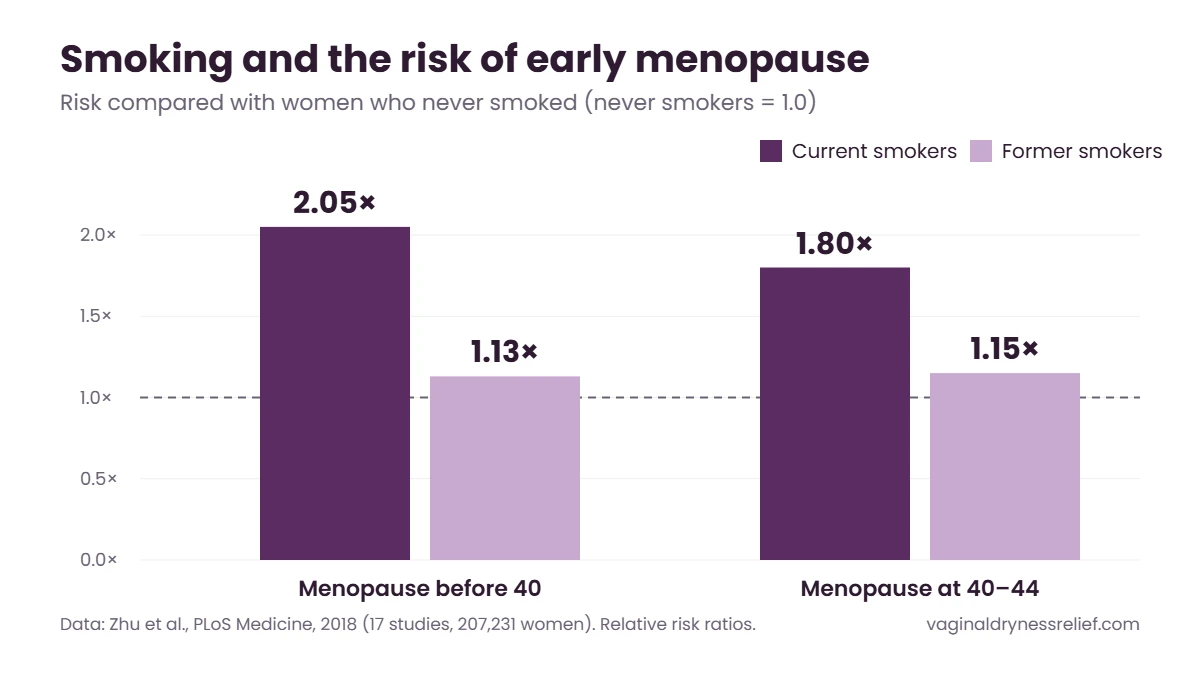
| Group | Menopause before 40 | Menopause at 40–44 |
|---|---|---|
| Never smokers | 1.0 (reference) | 1.0 (reference) |
| Current smokers | 2.05× | 1.80× |
| Former smokers | 1.13× | 1.15× |
The short version
- Mayo Clinic and Cleveland Clinic both list smoking as a risk factor for vaginal atrophy and lower estrogen [1][2][3].
- Women who smoke reach menopause earlier on average, and the risk rises with the number of years smoked [4][6].
- In a small lab study, nicotine alone reduced genital arousal in nonsmoking women by about 30% [5].
- Quitting helps: women who had quit for more than 10 years had about the same risk of early menopause as never smokers [4]. A moisturizer and lubricant can ease dryness in the meantime.
Can smoking cause vaginal dryness?
It can contribute, alongside other causes. Mayo Clinic lists cigarette smoking as a risk factor for GSM, the condition behind most menopause-related dryness [1]. Cleveland Clinic lists smoking among the things that can lower estrogen levels and cause vaginal dryness, and among the risk factors for vaginal atrophy [2][3].
Smoking is rarely the only reason. Menopause, breastfeeding, some medicines and cancer treatments are more common causes [2], so it helps to look at the whole picture. Our guide to the causes and symptoms of vaginal dryness covers them all.
By the numbers
- In a 2018 analysis of 17 studies and 207,231 women, current smokers had 2.05 times the risk of menopause before 40 and 1.80 times the risk of menopause at 40–44.
- According to Health Canada, people who smoke reach menopause about 1 to 2 years earlier than people who do not.
- In a randomized trial of 25 nonsmoking women, nicotine gum cut the genital arousal response by about 30% compared with placebo gum.
How does smoking affect vaginal moisture?
Doctors point to a few ways smoking may make dryness more likely. None of them works on its own, and the table below shows what each one is based on.
| How smoking may contribute | What the source says |
|---|---|
| Less blood flow | Smoking affects blood flow, so less blood and oxygen may reach the vagina and nearby areas [1]. |
| Weaker estrogen effect | Smoking reduces the effects of the estrogen the body makes [1] and is listed among things that lower estrogen levels [2]. |
| Earlier menopause | Smokers reach menopause about 1 to 2 years earlier, and the risk of early menopause rises with years smoked [4][6]. |
| Lower genital arousal | In a lab study, nicotine alone reduced the genital arousal response, which drives natural lubrication [5]. |
Does smoking cause earlier menopause?
Yes, on average. In a pooled analysis of 17 studies from seven countries, women who smoked at the time had about twice the risk of reaching menopause before 40 and 1.8 times the risk of reaching it at 40 to 44, compared with women who had never smoked [4]. The longer women had smoked, the higher the risk. Among current smokers who had smoked for 15 to 20 years, the risk of early menopause was 6.55 times higher [4].
Health Canada says people who smoke reach menopause about one to two years earlier and may also have worse menopausal symptoms [6]. Because falling estrogen around menopause is the most common cause of dryness, an earlier menopause can mean dryness starts earlier too. Read more about how dryness can start in your 40s in our guide to perimenopause vaginal dryness, and about GSM on our menopause and GSM page.
Does nicotine affect arousal and lubrication?
It may. In a randomized, double-blind trial, 25 young nonsmoking women chewed either 6 mg of nicotine gum or placebo gum before watching an erotic film. Nicotine reduced their genital arousal response by about 30%, although the women did not feel any less aroused [5]. Genital arousal is what increases blood flow and natural lubrication.
Because this study used nicotine gum rather than cigarettes, it suggests nicotine itself may play a part [5]. It was small and short-term, though, and we did not find studies that looked at vaping and vaginal dryness. If low desire or arousal is part of what you are noticing, our guide to low libido and vaginal dryness may help.
Quitting: the good news
Quitting is one of the best things you can do, for your vaginal health and everything else. In the 2018 analysis, former smokers had a much smaller increase in the risk of early menopause than current smokers, and women who had quit more than 10 years earlier had about the same risk as women who never smoked [4]. The authors concluded that quitting early has clear benefits [4]. Health Canada also says quitting may reduce the risk of early menopause, and the earlier the better [6].
Free help is available. In the U.S., you can call 1-800-QUIT-NOW for free coaching by phone, or text QUITNOW to 333888 [8]. Your doctor or pharmacist can talk with you about medicines that make quitting easier.
Comfort steps while you quit
You do not need to wait until you have quit to feel more comfortable. The Menopause Society says over-the-counter vaginal moisturizers and lubricants are enough for most women with mild symptoms [7].
- Use a vaginal moisturizer regularly. Moisturizers are used a few times a week, not just before sex. See how to choose a vaginal moisturizer.
- Use a lubricant for sex. Our guide to the best lubricant for menopause dryness explains what to look for.
- Allow more time for arousal. Arousal is what triggers natural lubrication.
- Stay active. Exercise supports blood flow and mood; see exercise and vaginal dryness.
- Manage stress. Many people smoke to cope with stress, and stress can affect arousal too. Our guide to stress and vaginal dryness has ideas.
- Ask about prescription options if you are past menopause. Low-dose vaginal estrogen, vaginal DHEA (prasterone) and ospemifene are prescription treatments for GSM to discuss with your clinician [7]. Compare them in how to treat vaginal dryness.
Looking for hormone-free everyday comfort?
If you want a hormone-free addition to your comfort routine, AIRS Advanced Intimate Renewal Serum is a cosmetic serum with hyaluronic acid in single-use applicators that helps moisturize and soothe delicate intimate skin. It is not a substitute for a prescribed medicine, so talk with your clinician about combining it with any treatment. Choose 1 box (20% off through December 31), subscribe & save 10%, or the 90-Day Regimen (3 boxes, $138/box through December 31, free shipping).
When to see a doctor
See your clinician if dryness or pain during sex keeps coming back even with a moisturizer or lubricant, or if you notice any of these:
- Bleeding after sex or any bleeding after menopause
- Burning when you urinate, urinary urgency or repeat urinary tract infections
- Itching, an unusual discharge or a strong odor
- Hot flashes, missed periods or other signs of menopause before age 45
- Pain during sex that is getting worse (see painful sex after menopause)
Our guide to talking with your doctor has questions to bring, and find a doctor and resources lists specialist directories.
Frequently asked questions
Can smoking cause vaginal dryness?
It can contribute. Mayo Clinic lists smoking as a risk factor for genitourinary syndrome of menopause (vaginal atrophy) because it reduces blood flow to the vagina and reduces the effects of the estrogen your body makes, and Cleveland Clinic lists smoking among the things that can lower estrogen levels. Smoking is also linked with earlier menopause.
Does smoking cause early menopause?
Studies link the two. In a 2018 analysis of 17 studies and more than 200,000 women, current smokers had about twice the risk of menopause before age 40 and 1.8 times the risk of menopause at 40 to 44 compared with women who never smoked. The risk rose with more years of smoking.
Does vaping or nicotine gum affect vaginal lubrication?
There is little research. In one small lab study, nonsmoking women who chewed nicotine gum had about 30% less genital arousal response to an erotic film than when they chewed placebo gum. That suggests nicotine itself may play a part, but it was a small, short-term study.
Will quitting smoking help vaginal dryness?
Quitting removes the effects of smoking on blood flow and estrogen that clinics describe, and in the 2018 analysis women who had quit for more than 10 years had about the same risk of early menopause as women who never smoked. Dryness has many causes, so a moisturizer and lubricant can help while you quit, and a clinician can check for other causes.
Where can I get help to quit smoking?
In the U.S., you can call 1-800-QUIT-NOW for free coaching by phone, or text QUITNOW to 333888. Your doctor or pharmacist can also talk with you about medicines that make quitting easier.
Related reading
- Vaginal dryness: causes and symptoms
- What is vaginal atrophy?
- Vaginal dryness in perimenopause
- Can stress cause vaginal dryness?
- Exercise and vaginal dryness
- How to treat vaginal dryness: options compared
- Menopause and GSM
- Find a doctor and resources
Sources
- Mayo Clinic. Genitourinary syndrome of menopause (vaginal atrophy): symptoms and causes. December 20, 2025.
- Cleveland Clinic. Vaginal dryness. Updated February 3, 2026.
- Cleveland Clinic. Vaginal atrophy. Updated April 10, 2023.
- Zhu D, Chung HF, Pandeya N, et al. Relationships between intensity, duration, cumulative dose, and timing of smoking with age at menopause: a pooled analysis of individual data from 17 observational studies. PLoS Med. 2018;15(11):e1002704.
- Harte CB, Meston CM. The inhibitory effects of nicotine on physiological sexual arousal in nonsmoking women: results from a randomized, double-blind, placebo-controlled, cross-over trial. J Sex Med. 2008;5(5):1184–1197.
- Health Canada. Tobacco, menstruation and menopause. Modified July 26, 2023.
- The North American Menopause Society. The 2020 genitourinary syndrome of menopause position statement. Menopause. 2020;27(9):976–992.
- Centers for Disease Control and Prevention. How to quit smoking (Tips From Former Smokers). Last reviewed September 27, 2024.