Yes. Early menopause and premature ovarian insufficiency (POI) can both cause vaginal dryness, because the ovaries make much less estrogen years earlier than expected [1][2]. The good news is that the dryness is treatable. Moisturizers, lubricants and vaginal estrogen can all help, and guidelines recommend hormone therapy for most women with POI until the usual age of menopause, unless there is a medical reason not to take it [1].
If you are dealing with vaginal dryness in your 20s, 30s or early 40s, it can feel confusing. Here is what POI and early menopause are, why they matter, and what helps.
The short version:
- POI means the ovaries stop working normally before age 40. Early menopause means periods stop between 40 and 44 [1].
- Low estrogen can thin and dry the vaginal tissue, just as it does at the usual age of menopause [2].
- Hormone therapy is usually recommended until the usual age of menopause to protect bones and heart, unless it isn’t safe for you [1][2].
- Hormone therapy taken by mouth or through the skin may not fully relieve vaginal symptoms. Vaginal estrogen, moisturizers and lubricants can be added [1].
- Some women with POI still ovulate now and then, so pregnancy is possible but uncommon [4].
What is the difference between POI, early menopause and premature menopause?
The difference is mainly age. The 2024 international POI guideline from ESHRE and partner societies defines POI as loss of ovarian activity before age 40, and early menopause as ovarian function stopping between ages 40 and 44 [1]. The NHS uses similar terms: “premature menopause” before 40 and “early menopause” before 45 [3].
According to the NICHD, POI is not quite the same as menopause. With POI, periods may come and go, and some women can still get pregnant. The NICHD calls older terms like “premature ovarian failure” inaccurate for this reason [4].
What causes it?
Early menopause can happen on its own or be caused by medical treatment. The NHS and The Menopause Society both list surgery to remove both ovaries (oophorectomy), chemotherapy and radiotherapy as causes [3][5]. The MSD Manual adds detail: chemotherapy with alkylating agents, ovarian radiation above 6 Gy, genetic conditions such as Turner syndrome and the FMR1 (fragile X) premutation, and autoimmune conditions such as thyroid disease and Addison disease [2]. In many women, no cause is found. The MSD Manual estimates that 39% to 67% of cases are idiopathic, meaning the cause is unknown [2].
If both ovaries are removed before 40, the ESHRE guideline says that counts as POI without any further testing [1]. Our guide to vaginal dryness after hysterectomy explains how surgery affects dryness.
| POI (premature ovarian insufficiency) | Early menopause | Typical menopause | |
|---|---|---|---|
| Age | Before 40 [1] | 40 to 44 [1] | Usually 45 to 55 [3]; average about 51 [2] |
| Periods | May stop, or come and go [4] | Stop | Stop |
| Chance of natural pregnancy | Low but possible, about 5% to 10% [4] | Not covered by the sources used here | Not possible after menopause [4] |
| Hormone therapy | Recommended until the usual age of menopause unless unsafe [1] | Advised to replace hormones because of bone and heart risks [3] | A personal decision with your clinician, based on symptoms |
| Vaginal dryness | Common; listed as an estrogen-deficiency sign [2] | Common; listed by the NHS [3] | Common |
| Bone and heart risk | Higher [1] | Higher [3] | Rises after menopause |
How common is early menopause?
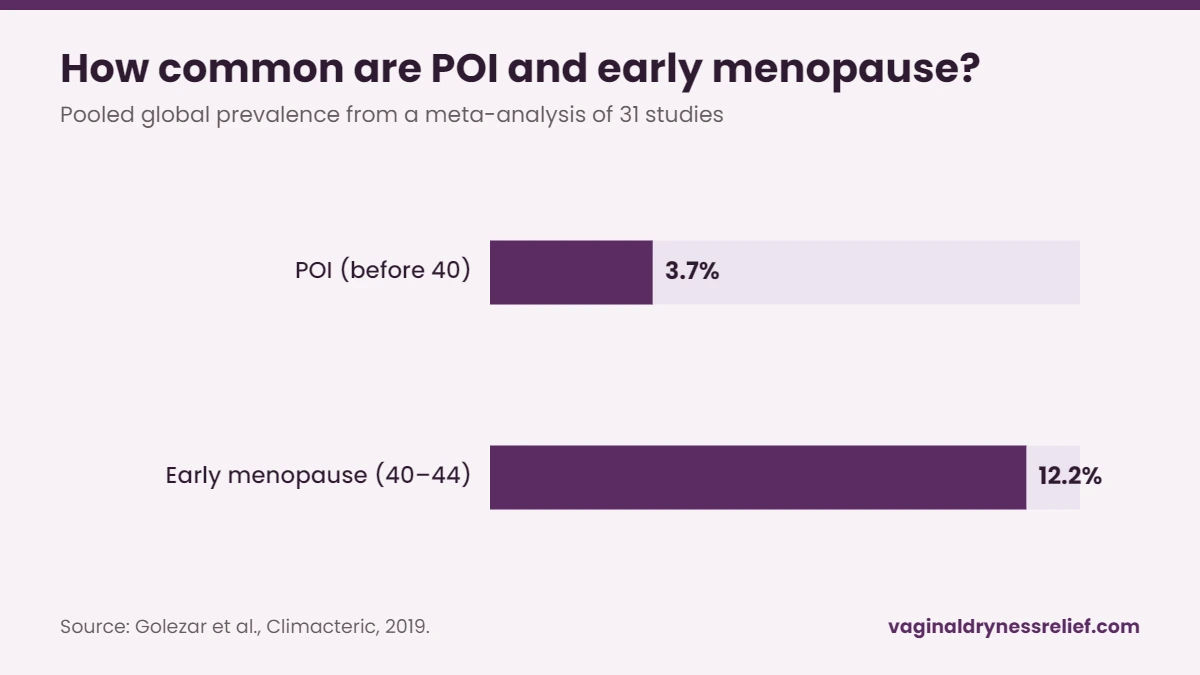
It is more common than most people think. A 2019 meta-analysis of 31 studies in Climacteric estimated that 3.7% of women worldwide have POI and 12.2% have early menopause [6]. It also found POI was more common in countries with a medium or low Human Development Index [6].
Other estimates are similar. The ESHRE guideline reports that POI without a medical cause was about 1% in older studies and about 3.5% in recent ones [1]. The Menopause Society says about 3 in 100 women go through menopause before age 40 [5].
By the numbers
- 3.7% of women have POI, and 12.2% have early menopause, in a 31-study meta-analysis [6]
- 4 months of irregular or missing periods is part of the POI diagnosis [1]
- 5% to 10% of women with POI get pregnant without treatment after diagnosis [4]
- Almost 9 in 10 women in one study reported moderate to severe distress after a POI diagnosis [4]
| Group | Percent |
|---|---|
| POI (before 40) | 3.7% |
| Early menopause (40–44) | 12.2% |
Why does early menopause cause vaginal dryness?
It comes down to estrogen. Estrogen helps keep the vaginal lining thick, moist and elastic, and when the ovaries make less of it, the tissue can become dry and fragile. The MSD Manual lists vaginal atrophy, vaginal dryness and lower libido among the signs of estrogen deficiency in POI [2], and the NHS lists vaginal dryness as a symptom of early menopause [3].
These changes are part of what doctors call genitourinary syndrome of menopause (GSM). Age does not protect you from them. In a 2026 study of more than 500 women published in Menopause, urogenital symptoms (such as vaginal dryness, burning, pain during sex and bladder problems) were the most commonly reported group of symptoms in both women with POI and women who reached menopause at the average age. Scores for these symptoms did not differ significantly between the two groups [7].
What other symptoms can POI or early menopause cause?
The main sign is periods that become irregular or stop before 45, according to the NHS [3]. Other symptoms can include:
- Hot flushes and night sweats [3]
- Vaginal dryness and pain during sex [2][3]
- Trouble sleeping [3]
- Low mood or anxiety [3]
- Reduced sex drive [3]
- Problems with memory or concentration [3]
- Difficulty getting pregnant [2]
Why does early menopause matter for your bones, heart and mood?
Losing estrogen years early raises some long-term health risks, which is why doctors take POI seriously even when symptoms are mild. The ESHRE guideline says POI is linked with lower bone density and a higher risk of heart disease, heart failure and stroke. Without hormone therapy, it is also linked with shorter life expectancy, largely because of heart disease [1].
The MSD Manual notes that without estrogen until about age 51, the risks of osteoporosis, dementia, Parkinson disease, depression and coronary artery disease go up [2]. The NICHD adds low thyroid function, anxiety and depression, and dry eye to the list of conditions linked with POI [4].
Is hormone therapy recommended?
For most women with POI, yes. The ESHRE guideline recommends hormone therapy for women with POI until the usual age of menopause to help prevent long-term health problems [1]. The MSD Manual describes giving it until about age 51 unless it is contraindicated, then deciding case by case [2]. The NHS lists HRT or the combined contraceptive pill as the main options when menopause starts before 45 [3].
It is not right for everyone. ESHRE says hormone therapy is generally not recommended after breast cancer and should be avoided with hormone-dependent tumours, while migraine alone is not a reason to avoid it [1]. Women who still have a uterus need a progestogen along with estrogen, and HRT does not work as birth control [1]. Your clinician can help you weigh these points.
How is POI diagnosed?
Diagnosis is based on your periods and a blood test. Under the 2024 ESHRE guideline, POI is diagnosed when a woman under 40 has had irregular or missing periods for at least 4 months and has a raised FSH (follicle-stimulating hormone) level above 25 IU/L [1].
- One raised FSH test is now enough. If the result is unclear, the test can be repeated after 4 to 6 weeks [1].
- AMH (anti-Müllerian hormone) should not be the main test [1].
- Pregnancy should be ruled out, and hormonal birth control may need to be stopped first because it can hide the pattern [1].
- The MSD Manual and NICHD describe repeat FSH testing about a month apart, which reflects older practice [2][4].
- Further tests may look for a cause, such as a chromosome test, FMR1 testing, or thyroid and adrenal antibodies [2].
- A bone density (DXA) scan is recommended at diagnosis where available [1].
What helps vaginal dryness with early menopause?
A layered approach works best: everyday comfort products, plus a prescription option if needed. The ESHRE guideline says lubricants and moisturizers can be used on their own or with other treatments, and that vaginal estrogen should be offered for genitourinary and sexual symptoms [1].
- Use a vaginal moisturizer regularly. Moisturizers are used on a schedule for everyday comfort, not just before sex. See moisturizer vs. lubricant for how they differ.
- Use a lubricant during sex. It reduces friction and pain in the moment [1][2].
- Ask about vaginal estrogen. ESHRE recommends offering it for genitourinary and sexual symptoms [1].
- Speak up if you are on HRT and still dry. Hormone therapy taken by mouth or through the skin may not fully relieve vaginal symptoms. ESHRE suggests adding vaginal estrogen in that case [1].
- Be cautious with laser treatments. ESHRE does not recommend laser or energy-based treatments as standard care because the evidence is inconclusive [1].
- After cancer, talk with your cancer team. If your early menopause followed cancer treatment, the safest options depend on the cancer type. Our guide to vaginal dryness after breast cancer covers this in more detail.
Can you still get pregnant with POI?
Sometimes, but the chances are low. The NICHD says 5% to 10% of women with POI get pregnant without medical help after diagnosis [4], and The Menopause Society puts the chance of natural pregnancy at under 10% [5].
ESHRE says no treatment has been reliably shown to restart the ovaries or raise natural pregnancy rates, and that egg donation is an established option [1]. Because pregnancy can still happen, contraception is advised if you want to avoid it [1]. If you are facing chemotherapy or radiation, fertility preservation can be considered before treatment [1]. The NHS also mentions IVF with your own frozen eggs or donor eggs, surrogacy and adoption [3].
How can you get emotional support?
A POI diagnosis can be hard, and support helps. The ESHRE guideline says POI can significantly affect psychological wellbeing and quality of life, and that women should be offered referral to support groups and mental health care [1]. In one study cited by the NICHD, almost 9 in 10 women reported moderate to severe emotional distress after diagnosis [4].
The Menopause Society notes that early menopause can affect self-image, body image, sexuality and fertility plans [5]. In the UK, NHS talking therapies can be accessed without seeing a GP first [3]. If you’re not sure how to bring up dryness or sex, our tips on talking to your doctor about vaginal dryness can help.
When should you see a doctor?
See a clinician if your periods change early or dryness is affecting your life. Make an appointment if:
- You are under 40 and have missed 3 or more periods [5]
- You are under 45 and have menopause symptoms such as hot flushes or vaginal dryness [3]
- Your periods have been irregular or missing for 4 months or more [1]
- You have had chemotherapy, pelvic radiation or ovary surgery and want a plan for bones, heart and symptoms [1][2]
- Vaginal dryness or pain during sex continues even with moisturizers, lubricants or HRT [1]
- Low mood or anxiety is affecting your daily life [1][3]
- You want to talk about fertility options [1]
Frequently asked questions
Does early menopause always cause vaginal dryness?
Not always, but it is common. The NHS lists vaginal dryness as a symptom of early menopause, and a 2026 study found urogenital symptoms were the most commonly reported group in women with POI [3][7].
Will HRT fix my vaginal dryness?
It often helps, but it may not fully relieve vaginal symptoms. The ESHRE guideline suggests adding vaginal estrogen if genitourinary symptoms continue on systemic hormone therapy [1].
Is POI the same as early menopause?
No. POI is loss of ovarian activity before 40, and early menopause is when it stops between 40 and 44 [1]. With POI, periods may come and go and pregnancy is still possible [4].
How long will I need hormone therapy if I have POI?
ESHRE recommends hormone therapy until the usual age of menopause, and the MSD Manual says about age 51, unless it isn’t safe for you. After that, the decision is made case by case [1][2].
Can chemotherapy cause early menopause?
Yes. Chemotherapy, especially alkylating agents, and radiation to the ovaries can cause POI, as can surgery to remove both ovaries [2][3].
Related reading
- Menopause & GSM guide
- Vaginal dryness in your 20s and 30s
- Vaginal dryness after hysterectomy
- Vaginal dryness after radiation
- Vaginal dryness in perimenopause
- Vaginal estrogen vs. hormone-free options
- Fertility-friendly lubricant
- Find a doctor & resources
Sources
- Panay N, Anderson RA, Bennie A, Cedars M, Davies M, Ee C, et al.; ESHRE, ASRM, CREWHIRL and IMS Guideline Group on POI. Evidence-based guideline: premature ovarian insufficiency. Human Reproduction Open, 2024;2024(4):hoae065. PMID 39660328. DOI 10.1093/hropen/hoae065. Link
- Pinkerton JV. Primary Ovarian Insufficiency. MSD Manual Professional Version, reviewed June 2026. Link
- NHS. Early or premature menopause. NHS website, reviewed 11 March 2025. Link
- Eunice Kennedy Shriver National Institute of Child Health and Human Development (NICHD). Primary Ovarian Insufficiency (POI) fact sheet. Link
- The Menopause Society. Premature Menopause. Updated June 5, 2025. Link
- Golezar S, Ramezani Tehrani F, Khazaei S, Ebadi A, Keshavarz Z. The global prevalence of primary ovarian insufficiency and early menopause: a meta-analysis. Climacteric, 2019;22(4):403–411. DOI 10.1080/13697137.2019.1574738. Link
- The Menopause Society. Psychological and urogenital menopause symptoms similar regardless of timing of menopause (press release on “Menopausal symptoms in average-age menopause and premature ovarian insufficiency,” Menopause), June 2026. Link