Radiation to the pelvis can leave the vagina drier, thinner, less stretchy and sometimes narrower or shorter, because it scars the tissue, damages small blood vessels and can stop the ovaries from working [6][9]. Regular, gentle use of a vaginal dilator after treatment, plus lubricants and moisturizers, is the main way cancer teams try to keep the vagina open and comfortable [1][7].
This guide explains what changes, when, and what most hospital leaflets advise. Your own radiation team’s instructions always come first.
The short version
- Pelvic radiation can cause dryness, narrowing (stenosis), shortening, sticking together of the vaginal walls, pain and light bleeding [6][9].
- Most leaflets say to start a dilator about 2 to 8 weeks after your last treatment, once soreness settles, not during treatment [1][2][4][8].
- Typical routine: 2 to 3 times a week for about 5 to 10 minutes, with a water-based lubricant [2][3][14].
- How long varies a lot: from 6 to 12 months to at least 5 years or lifelong, depending on the hospital [3][4][1].
- Vaginal estrogen, moisturizers and pelvic floor physical therapy are options to discuss with your oncology team [7][9][12].
Which cancers and treatments cause vaginal dryness after radiation?
Any radiation aimed at the pelvis can affect the vagina. That includes treatment for cervical, endometrial (uterine), rectal, anal and bladder cancers [9][10].
According to a 2017 review in the International Journal of Women’s Health, the risk of narrowing is highest with cervical cancer treated with chemoradiation plus brachytherapy. It is lower when brachytherapy is given only to the top of the vagina after surgery for endometrial cancer. Rectal and anal cancer treatment can also cause narrowing, and the dose the vagina receives helps predict risk [9]. Cancer Research UK notes that women treated with radiotherapy for bladder cancer may also have dryness and shrinkage of the vagina, and some have an early menopause [10].
Two types of radiation are involved. External beam radiation comes from a machine outside the body. Brachytherapy places a radiation source inside the body, often in the vagina or uterus. University College London Hospitals says both can cause scar tissue to form in the vagina [15].
Why does pelvic radiation cause dryness and narrowing?
Radiation damages the vaginal lining, its blood supply and, often, the ovaries. Together these make the tissue thin, dry and prone to scarring [6][9].
- Thinner lining. The American Cancer Society says radiation can damage the vaginal lining, making it thin and fragile [6].
- Less blood flow. Injury to tiny blood vessels can lead to low oxygen in the tissue and shrinking (atrophy) [9].
- Scarring (fibrosis). Extra collagen builds up under the lining, so the vagina loses stretch and can become shorter and narrower [9][4].
- Adhesions. As raw tissue heals, the walls can stick together. A Cochrane review describes radiotherapy as able to “make the sides stick together” [8][9].
- Early menopause. Radiation to the pelvis can affect the ovaries’ ability to make hormones. Smaller doses may allow periods to return; larger doses can cause permanent damage and early menopause, with hot flashes and vaginal dryness [6]. Read more in our guide to early menopause and vaginal dryness.
Low estrogen does not cause the narrowing by itself, but it reduces natural lubrication and thins the tissue, which makes symptoms worse [9]. For other causes, see vaginal dryness causes and symptoms.
What symptoms should you expect, and when?
Soreness usually starts during treatment and settles within weeks. Narrowing and scarring are late effects that can appear months to years later [6][9].
During treatment and the first few weeks
The ACS says the vagina may feel tender during radiation and for a few weeks afterward. Cancer Research UK adds that side effects tend to build gradually through treatment and for a few weeks after [6][11]. Rarely, open sores can form and take several months to heal [6].
Months to years later
Morris and colleagues explain that stenosis is classed as a late reaction (more than 3 months after radiation). It most often appears within the first year, but in one study moderate-to-severe narrowing kept increasing for up to 3 years [9]. Macmillan notes that bleeding can continue long term and some changes may be permanent [7].
Common symptoms include:
- Dryness and less natural lubrication [7]
- A vagina that feels shorter, tighter or less stretchy [7][4]
- Pain during sex or during pelvic exams [2]. See why sex can hurt and what helps.
- Light bleeding after sex or dilator use, because the walls are fragile [6][7]
- Walls sticking together (adhesions) [9]
Narrowing matters even if you are not sexually active. Cancer Council NSW points out that you will need regular pelvic exams after treatment, and a narrow vagina can make those painful [2].
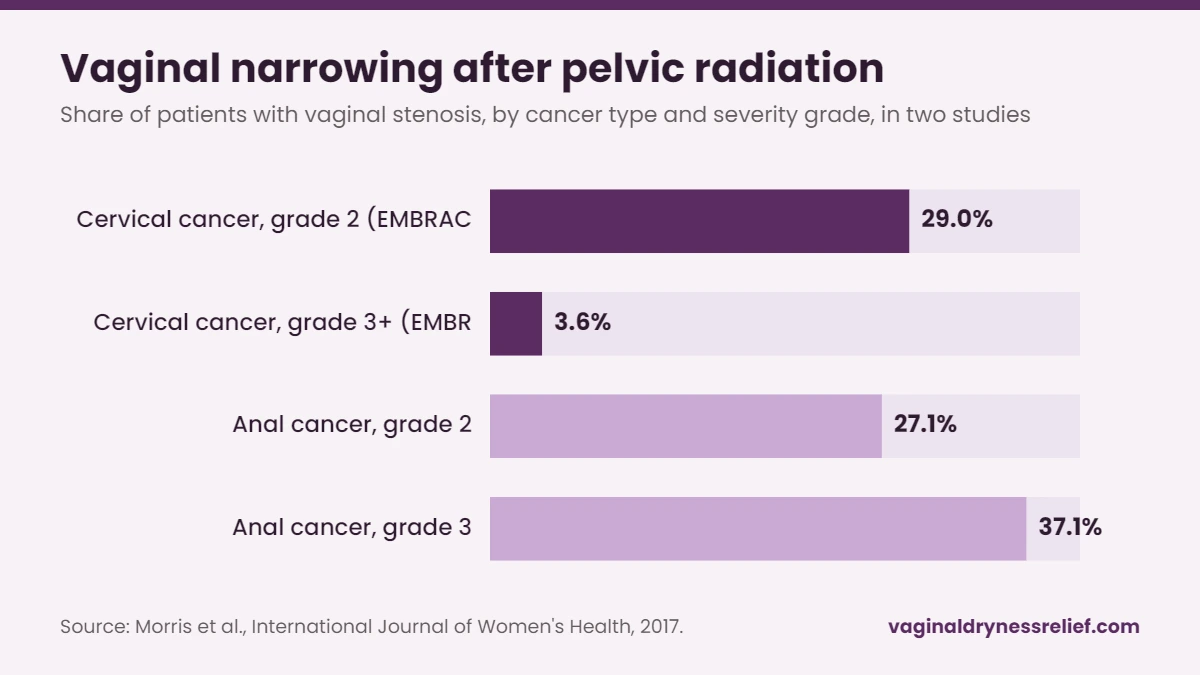
| Group | Percent |
|---|---|
| Cervical cancer, grade 2 (EMBRACE) | 29.0% |
| Cervical cancer, grade 3+ (EMBRACE) | 3.6% |
| Anal cancer, grade 2 | 27.1% |
| Anal cancer, grade 3 | 37.1% |
Reported rates vary hugely, from 1.25% to 88%, mostly because studies measure and grade narrowing differently. The authors think it is underreported [9].
How do vaginal dilators help after radiation?
A dilator is a smooth, tube-shaped device in graded sizes. Used regularly, it gently stretches the vagina and helps stop the walls from sticking together as they heal [2][4].
Be honest with yourself about the evidence. A 2014 Cochrane review by Miles and Johnson found no reliable trials. Limited observational data suggest regular stretching after radiotherapy ends may slightly reduce scarring, and it found no evidence to support dilating during radiotherapy [8]. Still, the review says women who want to keep vaginal length should consider it, and dilators remain standard advice in cancer centers [8][7].
When should you start, how often, and for how long?
Most leaflets say to start a few weeks after your last treatment, once soreness settles, and to use the dilator a few times a week for 5 to 10 minutes. How many months or years differs by hospital [1][2][3][4].
| Source | When to start | How often | Each session | For how long |
|---|---|---|---|---|
| OncoLink (Penn Medicine) [1] | 4–8 weeks after last treatment | At least 3 times a week | 5–15 minutes | Reviewed at 2-year follow-up; lifelong use often recommended |
| Cancer Council NSW [2] | Usually 4–6 weeks after last session | Once or twice a day for the first few months, then 2–3 times a week | 5–10 minutes | Several months, as your team advises |
| Royal Free London NHS [4] | 3–4 weeks after (6–8 weeks if sore) | Twice a week | About 5 minutes | 6–12 months |
| Guy’s and St Thomas’ NHS [3] | Not stated | 2–3 times a week | 5–10 minutes | At least 5 years, possibly lifelong |
| Alberta Health Services [5] | Not stated | At least 3 times a week | 10 minutes | 1 year, then as needed |
| Leeds Teaching Hospitals NHS [13] | About 2–6 weeks after | 3–4 times a week | About 10 minutes | First 2 years |
A consensus of experts summarized by Morris and colleagues suggested starting about 4 weeks after radiation, 2 to 3 times a week, and continuing for 9 to 12 months [9].
A typical session
- Find a private, relaxed time. Empty your bladder.
- Put a water-based lubricant on the rounded end of the dilator and at the vaginal opening [1][3]. Avoid oil-based products, lotion and petroleum jelly [1].
- Start with the smallest size and move up only when it feels comfortable [2][4].
- Breathe slowly and keep your pelvic floor muscles relaxed. Alberta Health Services advises not to tighten them while the dilator is in [5].
- Insert gently, then slowly move or rotate it for the time your team advises [2][13].
- Wash it in warm, soapy water, rinse well, dry it fully and store it clean [5].
Light spotting at first is common, as small bits of scar tissue break down [4][15]. Regular vaginal sex may replace some sessions, depending on how often you have it [3][4].
What about lubricants, moisturizers and vaginal estrogen?
Use a lubricant for dilators and sex, and a vaginal moisturizer on a regular schedule for everyday dryness. Vaginal estrogen may help some women, but whether it is right for you depends on your cancer, so ask your oncology team [7][9].
Macmillan explains the difference: a lubricant is used before or during sex to make the vagina wetter, while a moisturizer is applied regularly to draw moisture into the vaginal walls [7]. Our guide to moisturizer vs. lubricant covers how to choose.
Vaginal estrogen comes as a cream, tablet (pessary) or ring. Macmillan says it isn’t suitable for everyone [7]. Cancer Council NSW notes that a prescription hormone cream is “safe with many cancers of the uterus,” but that is a decision for your team [2]. Morris and colleagues report that vaginal estrogen may help the lining regenerate, and one study found less painful sex and less narrowing, but the research is small and flawed [9]. If your cancer was hormone-sensitive, see our page on vaginal dryness after breast cancer for how teams weigh this.
Can you have sex during and after pelvic radiation?
Often, yes, but ask your radiation team first. The ACS says many women can have sex between external beam treatments if they feel up to it, but sex is usually not allowed while a brachytherapy implant is in place [6].
After healing, Macmillan says vaginal shortening usually doesn’t stop vaginal sex [7]. Generous lubricant, trying different positions and using pelvic floor relaxation during penetration can help [7]. Ask how long to wait before unprotected sex or trying for a pregnancy [6].
Can pelvic floor physical therapy help?
It may. A pelvic floor physical therapist can teach relaxation, stretching and dilator techniques, though the evidence is still early [7][12].
A 2022 review in Frontiers in Medicine found only five studies of pelvic floor training after gynecologic radiation, and called the evidence too weak for firm conclusions [12]. In one uncontrolled study it described, women with painful sex after cervical or endometrial cancer had 12 weekly sessions combining education, manual therapy, pelvic floor training and dilator exercises. Their pain scores dropped by an average of 5.6 points on a 10-point scale [12]. Ask your team for a referral if dilators or sex stay painful.
Symptom guide: what helps and who to ask
| Symptom | What may help | Who to ask |
|---|---|---|
| Everyday dryness | Regular vaginal moisturizer; ask about vaginal estrogen [7] | Oncology nurse or doctor |
| Dryness or pain with sex | Water-based or silicone lubricant, positions, pelvic floor relaxation [7][13] | Oncology nurse; pelvic floor physical therapist |
| Tightness, narrowing or shortening | Regular dilator use after treatment [2][4] | Radiation team or clinical nurse specialist |
| Pain with dilators or exams | Smaller size, more lubricant, relaxation; physical therapy [5][12] | Clinical nurse specialist; physical therapist |
| Light spotting | Often normal early on; pause if needed [4][13] | Your team if it persists |
| Heavy bleeding, odor, fever | Stop and get checked [1][5] | Call your oncology team promptly |
When should you call your team?
Call your radiation or oncology team if bleeding is heavy or keeps going, or if you have signs of infection or a lot of pain [1][4][5]. Always tell them about any bleeding [7].
- Heavy bleeding, or more than about 1 tablespoon of blood after dilator use [5]
- Bleeding that persists between sessions [4][15]
- Discharge with a strong odor, vaginal itching, fever or abdominal pain [1]
- A lot of pain during or after dilator use or sex [1][15]
- Trouble using the dilator, or dryness that isn’t improving [13]
For more on bleeding, read can vaginal dryness cause bleeding? Our doctor conversation guide can help you raise these topics.
Frequently asked questions
Is vaginal dryness after radiation permanent?
It can be long-lasting. Radiation scarring is a late effect, and Macmillan notes some changes can be permanent, but moisturizers, lubricants and other treatments can make you more comfortable [7][9].
Should I use a dilator during radiation therapy?
Usually not. The Cochrane review found no evidence to support dilating during radiotherapy, and most leaflets say to start a few weeks after treatment ends [8][1].
How long do I need to use a vaginal dilator?
It depends on your hospital. Leaflets range from 6 to 12 months to at least 5 years, and some recommend lifelong use [4][3][1].
Is bleeding after using a dilator normal?
Light spotting is common early on. Call your team for heavy bleeding, bleeding that keeps going, or more than about a tablespoon of blood [4][5].
Can sex replace dilator use?
Sometimes. Guy’s and St Thomas’ says vaginal sex can replace dilators depending on how often you have it, so ask your team what counts for you [3].
Can I use vaginal estrogen after pelvic radiation?
Some women can. It isn’t suitable for everyone, so ask your oncology team based on your type of cancer [7][2].
Related reading
- Early menopause and vaginal dryness
- Vaginal dryness after breast cancer
- Vaginal dryness treatments (pillar)
- Vaginal moisturizer vs. lubricant
- Vaginal dryness after hysterectomy
- Painful sex after menopause
- Can vaginal dryness cause bleeding?
- Vaginal dryness resources and finding a doctor
Sources
- OncoLink (Penn Medicine). Vaginal Dilators for Radiation Therapy. OncoLink, accessed November 2026. Link
- Cancer Council NSW. Vaginal narrowing and dryness (Cancer of the uterus: managing side effects). Cancer Council, accessed November 2026. Link
- Guy’s and St Thomas’ NHS Foundation Trust. Vaginal dilators (leaflet 5555/VER1). Reviewed July 2026. Link
- Royal Free London NHS Foundation Trust. Using vaginal dilators after pelvic radiotherapy (RFL1090). Approved December 2023. Link
- Alberta Health Services, MyHealth.Alberta.ca. Female Sexuality and Cancer: Vaginal Dilators. Current as of September 27, 2024. Link
- American Cancer Society. How Radiation Therapy Can Affect Sex for Women. Revised April 15, 2025. Link
- Macmillan Cancer Support. Vaginal changes, sexual well-being and cancer. Reviewed March 1, 2024. Link
- Miles T, Johnson N. Vaginal dilator therapy for women receiving pelvic radiotherapy. Cochrane Database of Systematic Reviews, 2014, Issue 9. DOI: 10.1002/14651858.CD007291.pub3. Link
- Morris L, Do V, Chard J, Brand AH. Radiation-induced vaginal stenosis: current perspectives. International Journal of Women’s Health, 2017;9:273–279. DOI: 10.2147/IJWH.S106796. Link
- Cancer Research UK. Long term side effects of radiotherapy for bladder cancer. Reviewed August 21, 2025. Link
- Cancer Research UK. Side effects of radiotherapy to the abdomen or pelvis. Reviewed January 30, 2024. Link
- Barcellini A, Dominoni M, Dal Mas F, et al. Sexual Health Dysfunction After Radiotherapy for Gynecological Cancer: Role of Physical Rehabilitation Including Pelvic Floor Muscle Training. Frontiers in Medicine, 2022;8:813352. DOI: 10.3389/fmed.2021.813352. Link
- Leeds Teaching Hospitals NHS Trust. Vaginal care after pelvic radiotherapy. Reviewed December 23, 2025. Link
- Cambridge University Hospitals NHS Foundation Trust. Vaginal care following pelvic radiotherapy for anal cancer. Approved March 11, 2026. Link
- University College London Hospitals NHS Foundation Trust. Vaginal dilation therapy: information for patients who have completed radiotherapy treatment. Updated August 22, 2024. Link