Vulvar lichen sclerosus is a long-term inflammatory skin condition that most often causes itchy, white, thin patches on the vulva and the skin around the anus [1][3]. It is not an infection, and you cannot catch it or pass it on, including through sex [2][3]. There is no cure, but a strong prescription steroid ointment usually controls it well, and regular check-ups help catch rare problems early [2][3].
You may also see it called “vaginal dystrophy” or “vulvar dystrophy.” Those are older names. This guide explains what lichen sclerosus is, how it differs from menopause dryness and thrush, and how doctors diagnose and treat it.
What is vulvar lichen sclerosus?
It is a chronic skin condition in which inflammation makes the vulvar skin pale, thin and fragile. According to the Primary Care Dermatology Society (PCDS), it causes white patches that most often affect the genital and perianal skin, though it can appear elsewhere on the body [1].
The exact cause is not fully understood. The British Association of Dermatologists (BAD) says it is linked with autoimmune conditions such as vitiligo and thyroid disease, but it is not an allergy and is not caused by abnormal hormones [3]. The NHS adds that it is not caused by infection or poor hygiene [2]. In one review, about 30% of women with confirmed lichen sclerosus also had thyroid disease [8].
Friction and skin damage can trigger flares or make them worse. The BAD lists rubbing, urine leakage, and incontinence pads or panty liners as common irritants [3].
Why do people search for “vulvar dystrophy”?
Before the 1970s, doctors used vague labels such as leukoplakia, kraurosis and vulvar dystrophy for this condition. The International Society for the Study of Vulvovaginal Disease (ISSVD) discouraged those terms in 1976, and “lichen sclerosus” has been the accepted name since then [8]. If an older record or relative says “vulvar dystrophy,” it may refer to lichen sclerosus or to other skin changes, so ask your clinician which diagnosis applies to you.
Who gets lichen sclerosus?
It can happen at any age, but it is much more common in women over 50 [2]. A 2020 review describes two peaks: girls before puberty (average age about 7.6 years) and women around and after menopause (average age about 52.6 years) [8].
By the numbers
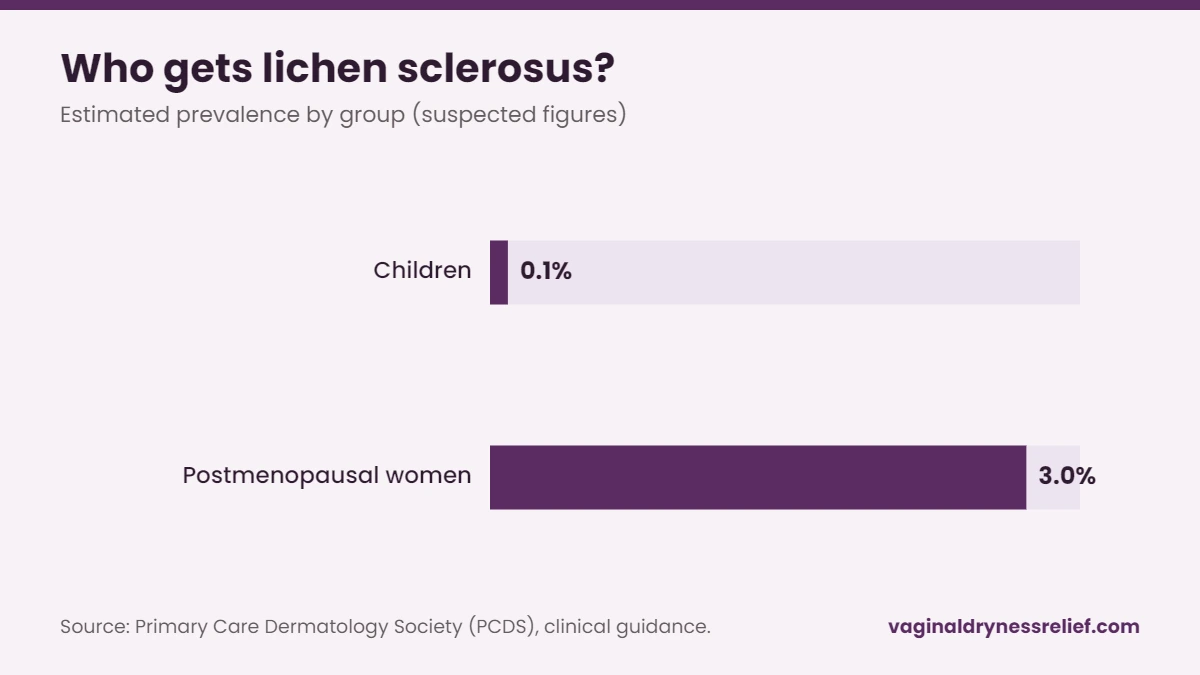
- About 3% of postmenopausal women may have lichen sclerosus, compared with about 0.1% of children [1].
- Up to 15% of cases occur in children [1].
- Itch is the main symptom in 93% of cases, but about 9% of people have no symptoms at all [4].
- Average age at diagnosis in adult women is 52–60 years [4].
- Thrush and menopause-related thinning are the most common misdiagnoses, which can delay diagnosis by up to 5 years [8].
True numbers are uncertain. The Irish Health Service Executive (HSE) guideline notes that lichen sclerosus is under-diagnosed, partly because some people have no symptoms [4].
| Group | Percent |
|---|---|
| Children | 0.1% |
| Postmenopausal women | 3.0% |
What are the symptoms?
The most common symptom is itching, which can be intense and disturb sleep [7]. Other signs build over time if the condition isn’t treated.
- Itching, often severe, and soreness or burning [1][4]
- White, shiny, thin or crinkled patches on the vulva; when the skin around the anus is also affected, the patches can form a “figure of eight” shape [1][3]
- Fragile skin that bleeds, bruises or splits (fissures) when rubbed or scratched [2][3]
- Pain during sex, because the vaginal entrance can narrow and the skin can tear [3]
- Pain when peeing or discomfort around the anus, including painful bowel movements [6][7]
- Scarring and changes in shape: the inner lips can shrink and the clitoris can become buried under its hood [2][6]
The PCDS notes that the vagina itself is not affected; the changes are on the vulvar skin [1]. In girls, symptoms can include itching, discharge, pain when peeing or constipation [1]. If you are noticing itching or burning and aren’t sure why, our guide to vaginal itching, burning and dryness covers other common causes.
How is it different from menopause dryness or thrush?
All three can cause itching and discomfort, but they have different causes and treatments. A 2020 review found that thrush and menopause-related thinning are the conditions lichen sclerosus is most often mistaken for [8].
| Feature | Lichen sclerosus | Menopause dryness (GSM) | Thrush |
|---|---|---|---|
| What it is | Long-term inflammatory skin condition [3] | Dryness and soreness often linked to menopause [10] | Yeast infection caused by candida [9] |
| Infection? Contagious? | No and no [2] | No | An infection, but not a sexually transmitted one [9] |
| Typical signs | White, shiny or crinkled patches on the vulva; skin tears easily [2][3] | Soreness or itching in and around the vagina, pain during sex, needing to pee more often [10] | Itching plus white discharge “like cottage cheese” that usually doesn’t smell [9] |
| Where | Vulva and skin around the anus; not inside the vagina [1] | In and around the vagina [10] | Vulva and vagina [9] |
| Usual first treatment | Strong prescription steroid ointment [1][3] | Moisturizers, lubricants; hormone treatment from a GP [10] | Antifungal tablet, pessary or cream; usually clears in 7–14 days [9] |
Some women have more than one condition at the same time. If antifungal creams keep “not working,” or dryness products don’t help a white or itchy patch, that is a good reason to ask for a vulvar exam. You can read more about menopause-related changes in our GSM guide.
How is lichen sclerosus diagnosed?
Usually an experienced clinician can diagnose it by looking at the skin [1][3]. A small skin sample (biopsy) is taken when the diagnosis is uncertain, the skin looks unusual, or treatment isn’t working as expected [3][4].
According to the BAD, a biopsy is also used if there is an open sore or a thickened area. It is done with local anesthetic and may need a stitch or two [3]. The HSE guideline says a biopsy must be considered if there is any suspicion of precancerous change or no response to an adequate steroid dose [4]. Some US sources, such as a 2020 American Family Physician review, describe biopsy as the way to make a definitive diagnosis [6], so practice varies. Girls with suspected lichen sclerosus should be seen by a specialist [1][3].
What is the first-line treatment?
The first-line treatment is a very strong (ultrapotent) steroid ointment, most often clobetasol propionate 0.05% [1][3]. The 2018 BAD guideline states that all the evidence points to a potent topical steroid ointment as the most effective treatment, used at first for about 3 months [5].
A common regimen, described by both the BAD patient leaflet and the PCDS, is [1][3]:
- Month 1: apply once a day
- Month 2: apply every other day
- Month 3: apply twice a week
- Then: review with your clinician to plan ongoing use
Other guidelines use slightly different schedules. For example, the 2020 American Family Physician review describes twice-daily use until active lesions settle, then tapering to once or twice a week [6]. Follow the plan your own clinician gives you. Ointments are generally preferred over creams [4][6].
Many people worry because the tube says not to use it on genital skin. The BAD leaflet explains that this warning does not apply when a specialist prescribes it for lichen sclerosus, and that weaker steroids are not effective for this condition [3]. Only a small amount is needed: a 30 g tube should last 3 months or longer [7].
What does maintenance look like?
Once symptoms are controlled, many people keep using the steroid once or twice a week to keep the skin calm [1][4]. The HSE says maintenance aims to control symptoms, prevent scarring and reduce cancer risk [4].
When cutting back, the HSE advises reducing how often you apply it rather than how much you use [4]. Flares can happen, and your clinician may suggest using it more often for a while [1]. The PCDS suggests a review if someone uses more than 30 g in 6 months [1].
What daily skin care helps?
Gentle care and plenty of emollient (a plain, fragrance-free moisturizer) help protect fragile skin. These support, but do not replace, prescribed treatment [3][4].
- Wash with an emollient soap substitute instead of soap, ideally one your doctor or pharmacist recommends [2][3]
- Apply emollient often, for example morning and evening and after using the toilet [3]
- Use a barrier such as a bland ointment or petroleum jelly to protect skin from urine [2][3]
- Pat dry gently after peeing; avoid rubbing and scratching [2][3]
- Skip scented soaps, bubble bath, shower gel, wet wipes and scented panty liners [2][3]
- Wear cotton or silk underwear and avoid tight clothing [2]
- Use a lubricant if sex is uncomfortable; vaginal dilators may also help [2][3]
- Stop smoking if you smoke [1][2]
Safety note: emollients that soak into clothing or bedding can make fabric catch fire more easily, so keep away from flames and cigarettes and wash fabrics often [2][3]. For more on persistent discomfort during intimacy, see our guide to painful sex after menopause. Our vulvar dryness guide also covers gentle outer-skin care.
Does lichen sclerosus raise cancer risk?
Yes, slightly. Lichen sclerosus is linked with a small increased risk of vulvar squamous cell carcinoma, a type of skin cancer, in the affected area [1][2].
Estimates vary: about 5% (PCDS) [1], 4–5% (American Family Physician) [6], up to 5% (HSE) [4], and less than 5 in 100 (BAD) [3]. The BAD says the risk is lower when symptoms are well controlled, and the PCDS notes it is higher in smokers [1][3]. The HSE explains that lichen sclerosus is not itself precancerous, but abnormal cells can develop within affected skin over time [4].
That is why long-term follow-up matters. The HSE suggests a review about 3 months after starting treatment and a yearly vulvar exam after that, which can happen in primary care if things are stable [4]. The BAD recommends lifelong self-checks [3]. Watch for:
- A lump or a thickened, raised area [2][3]
- A sore or ulcer that doesn’t heal [2]
- A crusted area, or bleeding that keeps happening [1][3]
- Persistent redness with a sharp edge [1]
When should you see a doctor?
See a clinician if you notice an itchy white patch on your genitals, or if symptoms don’t improve with treatment [2].
- An itchy white patch on your vulva or other skin [2]
- Repeated “thrush” that keeps coming back or doesn’t clear with antifungal treatment [8][9]
- Pain when peeing or during sex, even after a diagnosis [2]
- Skin changes still there more than 2 weeks after using your steroid, especially thickening, soreness or an ulcer [3]
- Any lump, non-healing sore, or bleeding: ask for an urgent review [1][2]
- A child with vulvar or anal itching, soreness or constipation [1][3]
Not sure how to bring it up? Our tips on talking to your doctor can help.
Which doctor treats lichen sclerosus?
You can start with a primary care doctor or gynecologist. If the diagnosis is unclear or the condition is hard to control, you may be referred to a dermatologist or a specialist vulval (vulvar) clinic [1][4].
The PCDS and HSE say stable, uncomplicated lichen sclerosus can be managed in primary care, while specialist care is advised for diagnostic doubt, thickened skin, poor response to treatment, major scarring, or any concern about precancerous change [1][4]. In the US, many gynecologists and dermatologists treat it, and some academic centers run vulvar clinics. Our find a doctor and resources page lists places to start.
Frequently asked questions
Is lichen sclerosus a sexually transmitted infection?
No. It is a skin condition, not an infection, and it cannot be spread by touch or sex [2][3].
Can lichen sclerosus be cured?
There is no cure, but a strong steroid ointment usually controls the symptoms and signs well [2][3]. Many people use it once or twice a week long term to prevent flares [4].
Is clobetasol safe to use on the vulva?
When prescribed for lichen sclerosus, yes. The BAD explains that the packaging warning about genital skin does not apply to this use, and evidence suggests few side effects with careful long-term use [3][6].
Is vulvar dystrophy the same as lichen sclerosus?
“Vulvar dystrophy” is an older, vague term that was used for lichen sclerosus and other vulvar skin changes before modern naming in the 1970s [8]. Ask your clinician which current diagnosis applies to you.
Will vaginal estrogen or moisturizers treat lichen sclerosus?
Guidelines name a potent steroid ointment as the effective treatment [5]. Emollients and soap substitutes help comfort and skin protection, but they don’t replace prescribed treatment [3][4].
How often do I need check-ups?
The HSE suggests a review about 3 months after starting treatment, then a vulvar exam at least once a year, plus regular self-checks at home [3][4].
Related reading
- Vulvar Dryness: Causes and Gentle Care
- Vaginal Itching, Burning and Dryness
- Menopause and GSM: The Complete Guide
- Vaginal Dryness: Causes and Symptoms
- What Is Vaginal Atrophy?
- Painful Sex After Menopause
- How to Talk to Your Doctor About Vaginal Dryness
- Find a Doctor and Resources
Sources
- Primary Care Dermatology Society (PCDS). Lichen sclerosus (female). Clinical guidance. Accessed November 2026. Link
- NHS. Lichen sclerosus. NHS website, reviewed 9 December 2024. Link
- British Association of Dermatologists. Lichen sclerosus in females. Patient information leaflet, skinhealthinfo.org.uk (updated September 2026). Link
- Roche L, Murphy C, McCarthy C, et al. Clinical update: Adult vulval lichen sclerosus (V1). Health Service Executive (Ireland), National Women and Infants Health Programme, February 2025. Link
- Lewis FM, Tatnall FM, Velangi SS, et al. British Association of Dermatologists guidelines for the management of lichen sclerosus, 2018 (plain language summary). Br J Dermatol. 2018;178(4):e309. DOI: 10.1111/bjd.16518. Full guideline: Br J Dermatol. 2018;178:839–853, DOI: 10.1111/bjd.16241; PMID: 29313888. Link
- Ringel NE, Iglesia C. Common benign chronic vulvar disorders. Am Fam Physician. 2020;102(9):550–557. Link
- O’Connell TX, Nathan LS, Satmary WA, Goldstein AT. Non-neoplastic epithelial disorders of the vulva. Am Fam Physician. 2008;77(3):321–326. Link
- Singh N, Ghatage P. Etiology, clinical features, and diagnosis of vulvar lichen sclerosus: a scoping review. Obstet Gynecol Int. 2020;2020:7480754. DOI: 10.1155/2020/7480754. PMID: 32373174. Link
- NHS. Thrush in men and women. NHS website, reviewed 28 July 2023. Link
- NHS. Vaginal dryness. NHS website, reviewed 24 July 2025. Link