A fertility friendly lubricant is one that has been tested and shown not to slow sperm down in the lab. Most standard lubricants, plus saliva and some oils, do reduce sperm movement in lab tests [1][2]. But the one real-world study of couples trying to conceive found that lubricant use did not lower their chance of getting pregnant [3]. So if dryness is making sex uncomfortable, you don’t have to put up with pain. You can choose a gentler option.
The short version:
- Dryness while trying to conceive is common. Stress, sex on a schedule and some fertility medicines can all play a part [1][2][9].
- In lab dishes, many common water-based lubricants cut sperm movement sharply [2][4].
- Lubricants based on hydroxyethylcellulose showed little or no harm to sperm in lab tests [1][2][4].
- In a study of 296 women trying to conceive, lubricant users were no less likely to get pregnant [3].
- Under 35, see a doctor after 12 months of trying. At 35 or older, after 6 months. Over 40, sooner [10][11].
Why does vaginal dryness happen when you’re trying to conceive?
Trying for a baby can change how sex feels. Pressure, strict timing and certain fertility medicines can all make natural wetness harder to come by.
Stress and scheduled sex. According to the American Society for Reproductive Medicine (ASRM), the stress of trying to conceive can lower sexual self-esteem, satisfaction and how often couples have sex. Strict timing around ovulation can make this worse [2]. The NHS notes that stress can also lower sex drive [12]. Not being fully aroused is a well-known cause of vaginal dryness [13]. Read more in our guide on whether stress can cause vaginal dryness.
Fertility medicines. Mayo Clinic Health System says some fertility medications can cause vaginal dryness, which makes couples more likely to reach for a lubricant [1]. For example, the U.S. prescribing label for clomiphene citrate, a common ovulation pill, lists vaginal dryness among side effects reported in fewer than 1% of people in clinical trials [9]. So it can happen, but it’s not common. Our list of medications that cause vaginal dryness covers other drugs too.
Everyday causes. The NHS also lists hormonal birth control, antidepressants, perfumed soaps and washes, and conditions like diabetes as causes of dryness [13]. If you’re in your reproductive years, see our overview of vaginal dryness in your 20s and 30s.
Do lubricants hurt sperm? What the lab studies show
In lab dishes, many do. ASRM reports that some water-based lubricants slowed sperm movement by 60% to 100% within 60 minutes in lab tests [2].
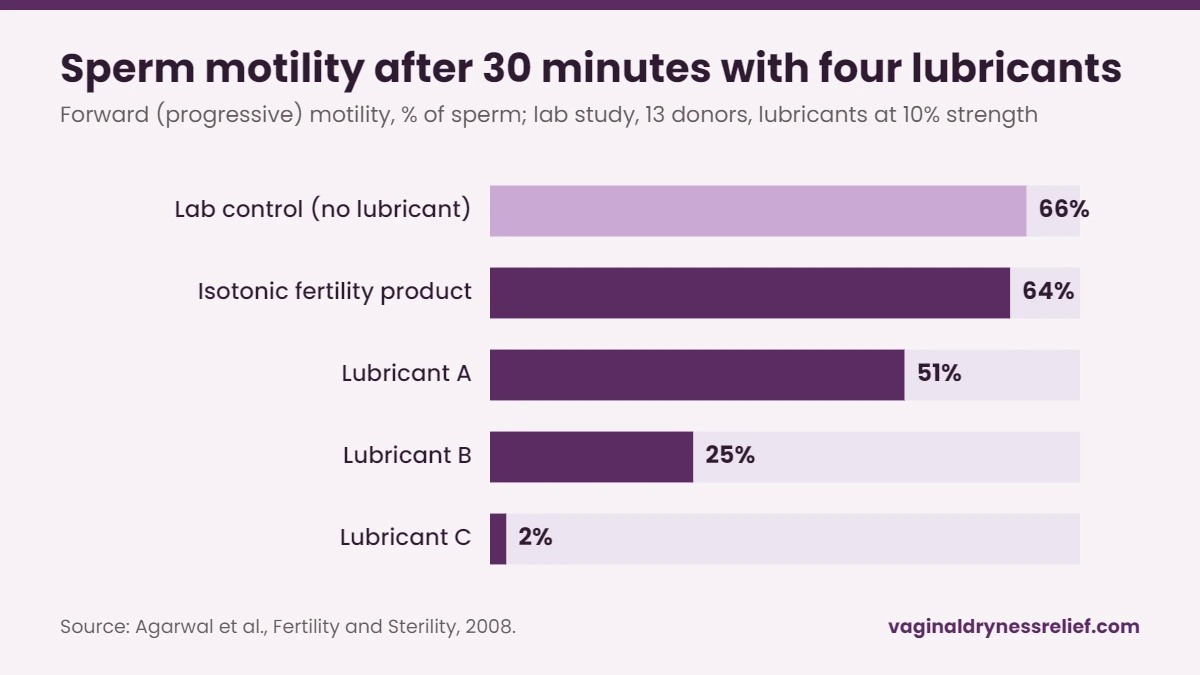
A 2008 study in Fertility and Sterility by Agarwal and colleagues mixed semen from 13 healthy donors with four lubricants (at 10% strength) for 30 minutes [4]. Forward-moving sperm dropped from 66% in the lab control to 51%, 25% and 2% with three of the products. The fourth, a product made for couples trying to conceive that the authors described as isotonic with a more natural pH, came in at 64%, which was not a significant change [4]. In a second test, two other lubricants caused slightly more sperm DNA damage than the control, while the fertility product did not [4].
| Group | Percent |
|---|---|
| Lab control (no lubricant) | 66% |
| Isotonic fertility product | 64% |
| Lubricant A | 51% |
| Lubricant B | 25% |
| Lubricant C | 2% |
Other lab studies point the same way. A 2014 study by Mowat and colleagues tested nine products on sperm from 10 fertility patients. Forward motility after 30 minutes ranged from 31% with the worst product to 86% with the best. The lubricants had no significant effect on sperm DNA [5]. In a 2025 study of 20 donors, the authors pointed to high osmolality (being very concentrated) and glycerin as likely reasons some products did the most harm [7].
Keep these results in context. These are lab tests, not bodies. A 2023 systematic review found 24 studies covering 35 lubricants. Only two looked at sperm inside the body, and pregnancy outcomes were rarely, if ever, reported. The authors concluded the data are too thin for a clear guideline [8].
Do lubricants actually make it harder to get pregnant?
The best real-world evidence says probably not. A 2012 study in Obstetrics & Gynecology by Steiner and colleagues followed 296 women aged 30 to 44 who were trying to conceive [3].
- About 25% said at the start that they used lubricant while trying to conceive. In daily diaries, 43% used it at least once [3].
- Women who used lubricant during their fertile window were just as likely to conceive in a given cycle as those who didn’t. The results were not statistically significant in either direction [3].
- The authors concluded lubricant use “does not appear to reduce the probability of conceiving,” but said a randomized trial is still needed [3].
Why the gap between the lab and real life? The researchers suggested lubricant may stay near the vaginal opening rather than up by the cervix, sperm move into the cervix quickly, and lubricant may make sex more frequent [3]. ASRM summarizes the evidence the same way: lab harm, but no drop in fertility in couples [2].
The honest take: it was one study with a modest number of women. If you want to play it safe, choosing a sperm-friendly option costs little. But you don’t need to avoid lubricant and endure painful sex.
What makes a lubricant “sperm-friendly”?
In short: it’s gentle on sperm in lab tests, close to the body’s own fluids in concentration and acidity, and free of extras like fragrance and parabens.
- Hydroxyethylcellulose (HEC) base. Mayo Clinic Health System says HEC-based lubricants don’t decrease sperm motility and most closely resemble natural fertile mucus [1]. ASRM agrees they showed no clear harm to semen in lab tests [2].
- Isotonic (low osmolality). Sperm do best in fluid close to the body’s own concentration, about 270 to 360 mOsm/L. One study notes motility falls about 50% above 400 and nearly stops above 600 [7]. Agarwal’s team described the products that harmed sperm most as above 1,000 mOsm/kg [4].
- Semen-like pH. Normal semen is slightly alkaline, about pH 7.2 to 8.5, and sperm movement drops below pH 6. The same authors found pH mattered less than concentration [7].
- No fragrance or parabens, per Mayo Clinic Health System [1].
- Labeled “fertility-friendly” or “sperm-friendly.” Mayo notes these products must be evaluated by the FDA to be sold, while “natural” or “organic” labels are not reviewed [1].
Curious how lubricants differ from everyday moisturizers? See vaginal moisturizer vs. lubricant.
What about saliva and household oils?
Saliva is not a good choice when trying to conceive, and oils have mixed results. Here’s what the sources say.
- Saliva slowed sperm in lab tests, even when diluted to 6.25% [2]. Mayo also lists it among things that slow sperm [1].
- Canola and mineral oil did not slow sperm in one lab study cited by ASRM [2]. Another found canola oil caused a small early dip, then motility stayed high [6].
- Baby oil results conflict: one study found motility stayed high after an early dip [6], another found it reduced motility at 30 minutes [7].
- Olive oil and sesame oil reduced sperm movement in lab tests [2][6]. Petroleum jelly reduced forward motility at 60 minutes in one study [7].
- Coconut oil and other household oils should not be used as lubricant, according to Mayo Clinic Health System [1]. See our article on coconut oil for vaginal dryness.
How do lubricant types compare when you’re trying to conceive?
This table sums up the lab evidence. Remember that lab results don’t always match real life [3][8].
| Type | Lab effect on sperm | Notes |
|---|---|---|
| HEC-based or isotonic, labeled sperm-friendly | Little or no drop in motility [1][2][4] | Closest to fertile mucus; look for no fragrance or parabens [1] |
| Typical water-based (often glycerin, high osmolality) | Large drops; 60%–100% within an hour in some tests [2][4] | Real-world study found no lower pregnancy rate [3] |
| Silicone-based | Little data in the studies we reviewed | Ask your clinician |
| Canola or mineral oil | No clear harm in one or two lab studies [2][6] | Limited data |
| Olive, sesame oil, petroleum jelly | Reduced motility [2][6][7] | Best avoided when trying to conceive |
| Saliva | Reduced motility even when diluted [1][2] | Not recommended |
What can help besides lubricant?
More time for arousal and less pressure around timing can both help.
- Slow down. Lack of arousal is a known cause of dryness. The NHS suggests trying different types of foreplay [13].
- Loosen the schedule. ASRM says chances are highest with sex every 1 to 2 days during the 6-day fertile window ending on ovulation day [2]. The NHS suggests every 2 to 3 days throughout the cycle [12]. You don’t have to hit one exact day.
- Talk openly with your partner. ASRM notes that fertility tracking should guide frequent sex, not replace it [2].
- Skip perfumed soaps, washes and douches, which can worsen irritation [13].
When should you see a fertility doctor?
It depends mostly on your age. ASRM and the American College of Obstetricians and Gynecologists (ACOG) use the female partner’s age to set the timeline [10][11].
- Under 35: after 12 months of regular, unprotected sex without pregnancy [10][11].
- 35 or older: after 6 months [10][11].
- Over 40: right away or soon. ASRM says more immediate evaluation may be warranted [10].
- Any age: sooner if you have irregular periods, known endometriosis or tubal disease, past pelvic infection, or a partner with known fertility problems [10][11].
The NHS gives similar advice: see a GP after a year of trying, or sooner if you’re 36 or older or know of a possible fertility problem [12].
When is dryness a sign of something else?
Dryness that lasts or comes with other symptoms deserves a checkup. Talk to a doctor if you notice [13]:
- Dryness that lasts a few weeks and isn’t helped by self-care
- Unusual discharge, itching or soreness
- Bleeding after sex or between periods
- Pain during sex that doesn’t ease with lubricant
- Peeing more often or repeat urinary tract infections
Dryness can also be linked to hormones, medicines or conditions like diabetes [13]. Our vaginal dryness causes and symptoms guide walks through the options. It’s also worth telling your fertility team about any new symptoms after starting a medicine.
Frequently asked questions
What is a fertility friendly lubricant?
It’s a lubricant shown in lab tests not to slow sperm. Sources point to hydroxyethylcellulose-based products that are close to body fluids in concentration and pH and free of fragrance and parabens [1][2][7].
Does regular lube stop you from getting pregnant?
Many regular lubricants slow sperm in lab dishes [2][4]. But a study of 296 women trying to conceive found lubricant use did not lower their chance of pregnancy [3].
Is saliva safe to use as lube when trying to conceive?
It’s best avoided. Saliva slowed sperm in lab tests, even when diluted [1][2].
Can fertility drugs cause vaginal dryness?
Some can. Mayo Clinic Health System notes certain fertility medicines can cause dryness [1], and the clomiphene label lists vaginal dryness as a rare side effect (under 1%) [9].
Is coconut oil a fertility-friendly lubricant?
Mayo Clinic Health System advises against using household oils such as coconut oil as lubricant [1]. Lab results for other oils are mixed [2][6][7].
How long should we try before seeing a fertility doctor?
Under 35, after 12 months of trying. At 35 or older, after 6 months. Over 40, sooner, according to ASRM and ACOG [10][11].
Related reading
- Vaginal dryness: causes & symptoms
- Vaginal moisturizer vs. lubricant
- Can stress cause vaginal dryness?
- Medications that cause vaginal dryness
- Vaginal dryness in your 20s and 30s
- Coconut oil for vaginal dryness
- Vaginal dryness during pregnancy
- Low libido and vaginal dryness
Sources
- Ogle A. Trying to get pregnant? Select a lubricant that is most helpful for sperm. Mayo Clinic Health System, Speaking of Health, Nov 17, 2022. Link
- Practice Committee of the American Society for Reproductive Medicine. Optimizing natural fertility: a committee opinion. Fertil Steril. 2022;117:53–63. Link
- Steiner AZ, Long DL, Tanner C, Herring AH. Effect of vaginal lubricants on natural fertility. Obstet Gynecol. 2012;120(1):44–51. PMID: 22914390. DOI: 10.1097/AOG.0b013e31825b87ae. Link
- Agarwal A, Deepinder F, Cocuzza M, Short RA, Evenson DP. Effect of vaginal lubricants on sperm motility and chromatin integrity: a prospective comparative study. Fertil Steril. 2008;89(2):375–379. DOI: 10.1016/j.fertnstert.2007.02.050. Link
- Mowat A, Newton C, Boothroyd C, Demmers K, Fleming S. The effects of vaginal lubricants on sperm function: an in vitro analysis. J Assist Reprod Genet. 2014;31(3):333–339. DOI: 10.1007/s10815-013-0168-x. Link
- Sandhu RS, Wong TH, Kling CA, Chohan KR. In vitro effects of coital lubricants and synthetic and natural oils on sperm motility. Fertil Steril. 2014;101(4):941–944. DOI: 10.1016/j.fertnstert.2013.12.024. Link
- Pradit L, Somsak P, Piromlertamorn W, Pantasri T, Sanmee U. The effects of coital lubricants on sperm motility and vitality. JBRA Assist Reprod. 2025;29(2):311–316. DOI: 10.5935/1518-0557.20240113. Link
- Gumerova E, Rimmer MP, Gellatly SA. Do sperm and lubricants gel well with each other? A systematic review. Hum Fertil. 2023;27(1). DOI: 10.1080/14647273.2023.2285349. Link
- Clomiphene citrate tablets: prescribing information (Accord Healthcare), issued August 2025. Drugs.com professional monograph. Link
- Practice Committee of the American Society for Reproductive Medicine. Fertility evaluation of infertile women: a committee opinion. Fertil Steril. 2026. Link
- Phillips K, Olanrewaju RA, Omole F. Infertility: evaluation and management. Am Fam Physician. 2023;107(6):623–630. Link
- NHS. Infertility. Reviewed August 9, 2023. Link
- NHS. Vaginal dryness. Reviewed July 24, 2025. Link