Coconut oil may make dryness and intimacy more comfortable for some women, but the proof is thin: one small, uncontrolled survey study plus a lot of personal stories. Used on the outer skin (the vulva) by someone who isn’t allergic, it’s generally low-risk. It should never be used with latex condoms, and inside the vagina it may carry a small infection risk, so a product made for vaginal use is usually the safer first choice.
- Evidence: one pilot survey of 53 women reported less pain and dryness, but it had no comparison group [1].
- Condoms: oil-based products can weaken latex and break a condom [3].
- Infection: a US study linked putting oils inside the vagina with more yeast (Candida) [6][7].
- Safer first picks: a water-based or silicone lubricant for sex and a vaginal moisturizer for everyday comfort [5][8].
Why do people use coconut oil for vaginal dryness?
It’s cheap, easy to find, feels “natural” and stays slippery for a long time. Medical News Today notes that coconut oil is thicker than many oils, so it may need less reapplying [11].
Doctors don’t fully agree on it. In one Cleveland Clinic article, a gynecologist lists coconut oil among the oils she’s comfortable recommending as a lube alternative, preferably organic, as long as you aren’t using latex condoms [10]. In another Cleveland Clinic article, an Ob/Gyn advises against oils because they “destroy latex condoms” and are greasy and hard to wash off [9]. Both agree on one point: oils and latex don’t mix.
If you’re weighing kitchen-cupboard options in general, our guide to natural remedies for vaginal dryness covers what has evidence and what doesn’t.
What does the research say about coconut oil for dryness?
Only one study has tested coconut oil for vaginal dryness, and it was a small pilot survey. Its results were encouraging, but its design means it can’t prove that coconut oil works.
In 2023, researchers in Pennsylvania published a survey of women using virgin coconut oil in a soft paste form (not melted) [1]. They analyzed 53 women: 31 had a rheumatic autoimmune disease, mostly rheumatoid arthritis or Sjögren’s, and 22 did not. Most (83%) were postmenopausal. Women applied 2 to 4 teaspoons inside and around the vagina right before intercourse, for at least six months. Women who used latex condoms or had a coconut allergy were excluded [1].
By the numbers: the coconut oil pilot study
- 53 women analyzed (67 surveyed) [1]
- Pain with intercourse fell from 4.1 to 1.5 on a 0–5 scale, on average [1]
- 82.7% said their vaginal dryness improved [1]
- 0 side effects were reported [1]
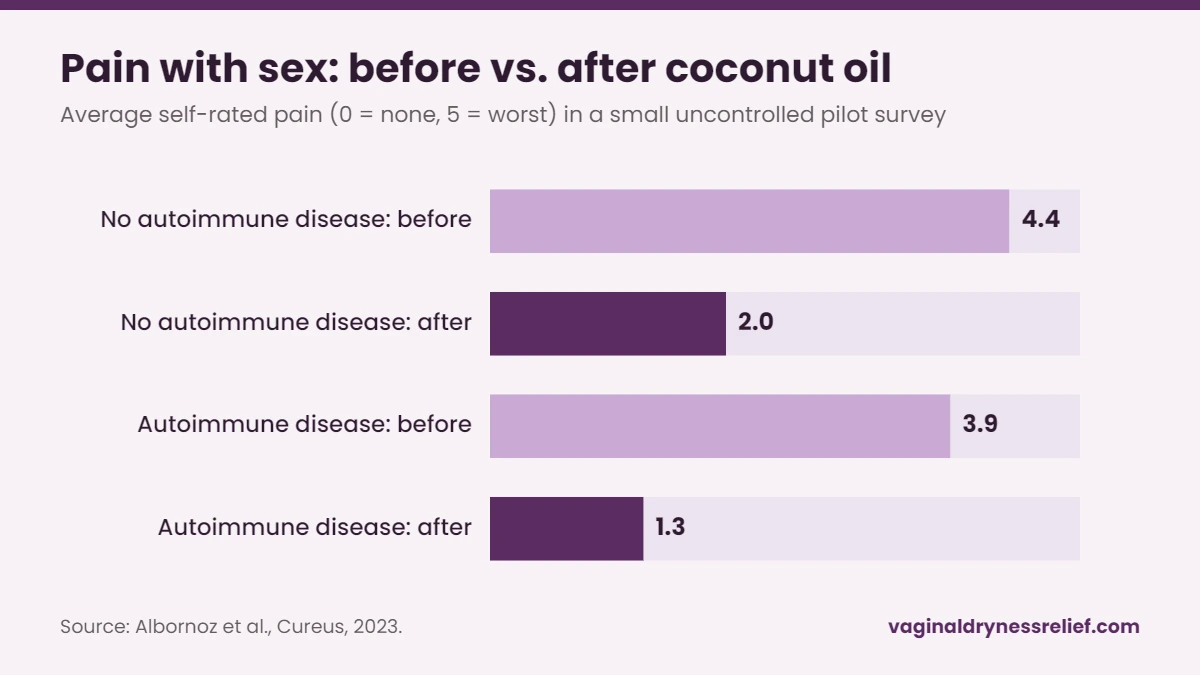
| Group | Value |
|---|---|
| No autoimmune disease: before | 4.4 |
| No autoimmune disease: after | 2.0 |
| Autoimmune disease: before | 3.9 |
| Autoimmune disease: after | 1.3 |
Why these results aren’t proof
The authors themselves list the study’s limits [1]:
- No control group. Nobody used a placebo or a standard lubricant for comparison, so we can’t tell how much of the benefit came from any lubricant at all.
- Not randomized or blinded. Women knew what they were using.
- A homemade scale. Symptoms were rated on a six-point scale the lead researcher created, which has not been validated.
- Small and specific. 53 women, one brand of oil, one clinic, and many with autoimmune disease.
- Loose statistics. The authors counted results as significant at p < 0.1, a lower bar than the usual 0.05. Most women said coconut oil was better than vaginal estrogen, but that comparison was not statistically significant.
The authors call for larger, better-designed studies [1]. Until those exist, Medical News Today’s summary still holds: the evidence for coconut oil as a vaginal lubricant is largely anecdotal [11]. If you live with an autoimmune condition, see our guide to Sjögren’s and vaginal dryness.
Does coconut oil fight yeast and bacteria?
In a lab dish, yes, coconut oil can stop yeast from growing. In real women, the limited data point the other way for oils used inside the vagina.
A 2007 lab study from Nigeria tested virgin coconut oil on 52 Candida (yeast) samples taken from patients. Undiluted oil stopped the growth of all 52, and diluted to 25% it still stopped 87% [2]. That sounds impressive, but a lab dish isn’t a vagina. The study involved no patients and can’t tell us whether coconut oil prevents or treats infections in the body.
Real-world data are less reassuring. A US study by Brown and colleagues followed women in Los Angeles who reported what they put in the vagina and were tested for infections [6]. According to Reuters’ report on the study, 44% of women who used oils inside the vagina tested positive for Candida, compared with 5% of women who didn’t [7]. The same study linked petroleum jelly with bacterial vaginosis (BV): 40% of users had BV versus 18% of non-users [7].
Keep this in perspective. The study was small, it shows a link rather than cause, and the published summaries don’t say which oils were used; a BC Centre for Disease Control summary names baby oil [6]. Still, it’s a reason not to use coconut oil to “treat” a yeast infection, and to be cautious if you get infections often.
Is coconut oil safe to use with condoms?
Not with latex condoms. According to the CDC, “Oil-based lubricants (petroleum jelly, body lotions, etc.) can weaken latex and break the condom” [3].
Mayo Clinic gives the same advice: avoid petroleum jelly or other oil-based products for lubrication if you’re also using condoms, because they can break down latex on contact [5]. A 2013 review in the Journal of the International AIDS Society describes lab tests in which vaginal products containing vegetable oil weakened latex condoms [4]. Real-world breakage studies are mixed, the review notes, but one Dutch study found condom failure rates of 10.3% with oil-based lubricants versus 1.7% with water-based ones [4].
Medical News Today adds that oil can also damage latex diaphragms [11]. If you rely on condoms for pregnancy or STI protection, choose a water-based or silicone-based lubricant instead [5][9].
What are the other risks?
Beyond condoms and infection, the main concerns are allergy, mess and a lack of safety data.
- Allergy or irritation. Skip it if you’re allergic to coconut. The pilot study excluded women with coconut allergy and had everyone test a little on the forearm first [1]. Medical News Today suggests a 24-hour patch test and stopping if you notice itching, redness or swelling [11].
- Staining and cleanup. Oil can stain underwear, sheets and clothing [11], and it’s greasy and hard to wash off [9].
- Vaginal pH. We found no study that measured coconut oil’s effect on vaginal pH. Medical News Today notes that lubricants in general may disturb pH and raise infection risk, so people prone to infections should check with a doctor first [11].
- Not designed for the vagina. The NHS advises against creams, lotions or moisturizers that aren’t intended for the vagina, because they can cause more irritation or infection [8].
Is coconut oil safer on the vulva than inside the vagina?
Probably, yes. Using a thin layer on the outer skin is closer to how coconut oil has been studied on skin, while the infection link involved putting oils inside the vagina.
Medical News Today points to skin studies suggesting coconut oil is generally safe on skin and can ease dryness [11]. The yeast finding above came from intravaginal use [6][7]. So if you want to try it, the outer lips and opening are the lower-risk place to start. Our guide to vulvar dryness covers other gentle care for that area.
How does coconut oil compare with lubricants and moisturizers?
Products made for vaginal use have clearer guidance behind them. Lubricants are for sex; moisturizers are for everyday comfort [5][9].
| Option | Main use | Safe with latex condoms? | What the evidence or guidance says | Downsides |
|---|---|---|---|---|
| Coconut oil | Lubricant during sex; some use it on the vulva | No [3] | One small uncontrolled pilot survey [1] | Weakens latex; possible yeast link inside the vagina [7]; stains [11] |
| Water-based lubricant | During sex | Yes [9] | Recommended by the NHS before sex [8] | Can dry out sooner; some people react to glycerin or warming agents [5] |
| Silicone-based lubricant | During sex | Yes [9] | Listed by Mayo Clinic as an option [5] | Harder to wash off than water-based |
| Vaginal moisturizer | Everyday comfort, used every few days | Check the label | Recommended by Mayo Clinic and the NHS for dryness [5][8] | Not a substitute for lubricant during sex [9] |
For a deeper look at the two product types, read vaginal moisturizer vs. lubricant.
What are safer alternatives to coconut oil?
For most women, a vagina-friendly lubricant plus a regular vaginal moisturizer is the simplest, best-supported starting point.
- Use a water-based lubricant before sex, inside and outside the vagina, as the NHS advises [8].
- Choose a silicone-based lubricant if you want something longer-lasting that’s still condom-safe [5][9].
- Use a vaginal moisturizer every few days; its effects tend to last longer than a lubricant’s [5].
- If you’re sensitive, skip lubricants with glycerin or warming ingredients [5].
- Avoid perfumed soaps, washes and douches in and around the vagina [8].
- If you still want coconut oil: use plain virgin oil on the vulva, patch-test first, never with latex condoms, and stop if you notice itching, odor or discharge.
Our guide to the best lubricant for menopause dryness explains what to look for on a label, and the vaginal dryness treatments guide covers prescription options to ask about if over-the-counter products aren’t enough.
Looking for hormone-free everyday comfort?
If you want a hormone-free addition to your comfort routine, AIRS Advanced Intimate Renewal Serum is a cosmetic serum with hyaluronic acid in single-use applicators that helps moisturize and soothe delicate intimate skin. It is not a substitute for a prescribed medicine, so talk with your clinician about combining it with any treatment. Choose 1 box (20% off through December 31), subscribe & save 10%, or the 90-Day Regimen (3 boxes, $138/box through December 31, free shipping).
When should you see a doctor?
See a doctor if home care isn’t helping or you notice signs of infection. The NHS suggests seeing a GP if [8]:
- You’ve had vaginal dryness for a few weeks and things you’ve tried aren’t working
- Dryness is affecting your daily life
- You have unusual vaginal discharge
- You have bleeding after sex, between periods or after menopause
- You also notice itching, burning, odor or a rash after using coconut oil or any new product
Frequently asked questions
Is coconut oil a good lubricant for vaginal dryness?
It can feel slippery and long-lasting, and one small pilot survey reported less pain and dryness [1]. But that study had no comparison group, and coconut oil weakens latex condoms [3], so a water-based or silicone lubricant is the safer default.
Can coconut oil cure a yeast infection?
No study in women shows that. Coconut oil stopped yeast in a lab dish [2], but a US study found more Candida among women who put oils inside the vagina [7]. See a clinician for suspected infections.
Can I use coconut oil with condoms?
Not with latex condoms. The CDC says oil-based lubricants can weaken latex and break the condom [3]. Use a water-based or silicone-based lubricant instead [9].
Is virgin or refined coconut oil better?
The only study used virgin coconut oil in paste form [1]. No research has compared virgin and refined oil for vaginal use, so there’s no evidence that one is safer.
Can I use coconut oil for dryness after menopause?
Most women in the pilot study were postmenopausal [1], but the evidence is still weak. Products made for vaginal use, or prescription options from your clinician, have stronger support [5].
Related reading
- Natural remedies for vaginal dryness
- Vaginal moisturizer vs. lubricant
- Best lubricant for menopause dryness
- Vaginal dryness treatments
- Vulvar dryness
- Vaginal moisturizer guide
- Vitamin E suppositories for vaginal dryness
- Sjögren’s and vaginal dryness
Sources
- Albornoz MA, Burke JF, Threlfall EK. Virgin coconut oil in paste form as treatment for dyspareunia and vaginal dryness in patients with and without rheumatic autoimmune diseases: an efficacy and safety assessment pilot study. Cureus, 2023;15(6):e40501. PMID 37461787. DOI 10.7759/cureus.40501. Link
- Ogbolu DO, Oni AA, Daini OA, Oloko AP. In vitro antimicrobial properties of coconut oil on Candida species in Ibadan, Nigeria. Journal of Medicinal Food, 2007;10(2):384–387. PMID 17651080. DOI 10.1089/jmf.2006.1209. Link
- Centers for Disease Control and Prevention (CDC). Condom use: an overview. 2024. Link
- Geibel S. Condoms and condiments: compatibility and safety of personal lubricants and their use in Africa. Journal of the International AIDS Society, 2013;16(1):18531. PMID 23841994. DOI 10.7448/IAS.16.1.18531. Link
- Mayo Clinic. Vaginal atrophy: diagnosis and treatment. Updated Dec 20, 2025. Link
- BC Centre for Disease Control, SmartSexResource. Journal club: intravaginal practices and risk of bacterial vaginosis and candida infection (summary of Brown JM et al., Obstetrics & Gynecology, 2013;121(4):773–780; PMID 23635677; DOI 10.1097/AOG.0b013e31828786f8). 2013. Link
- Doyle K (Reuters). Some popular vaginal products linked to infections, study finds. NBC News, 2013 (secondary report on Brown et al., Obstetrics & Gynecology, 2013). Link
- NHS. Vaginal dryness. Reviewed 24 July 2025. Link
- Cleveland Clinic. What works for vaginal dryness, and is natural best? Feb 15, 2022. Link
- Cleveland Clinic. Lubricant alternatives: what to use and what to avoid. Mar 28, 2023. Link
- Galan N; reviewed by Wilson DR. Coconut oil for vaginal dryness: does it work and how to use it safely. Medical News Today, updated Apr 12, 2023 (secondary source). Link